
Glute training is super hot right now… still. Usually fads and trends fade in the fitness industry, but this one is sticking around. And for good reason!
The most obvious and common reason to work the glutes is that it makes us more attractive. Everybody likes a nice ass, let’s be real. Straight men like women with nice ass, straight women like guys with a nice ass, gay guys like nice ass, and gay women like nice asses. Everybody wants that junk in the trunk. We’ve even written many love songs about dat booty (My favorite is the cover of “Baby got Back” by Jonathan Coulton which the TV Show Glee shamelessly stole without attributing or compensating…)
But it's not Just vanity!! Actual Health Benefits
It’s not just about getting that Honky-Tonk Badonkadonk that’ll make Trace Atkins slap his grandma. No. There’s actual benefits to working on your glutes more. (why are all my musical references over 20 years old??)
The physical benefit that has impacted me the most with glute training is the knee stability. As you may know from my personal history, I suffered a pretty nasty accident that required significant reconstruction of my knee. Luckily, stronger glutes provide more support at the knee joint, something I was lacking after the operation
For many of my clients, the biggest benefit of glute training is the effects it has on low back health. Strong, working glutes helps take off a significant load from the low back muscles and helps to prevent and reverse low back pains in many people.
For those that still enjoy playing sports either recreationally or competitively, the glutes are responsible for most of your running and jumping power as well as speed.
That junk in your trunk is really awesome! So let’s hit them correctly by breaking down the major muscles and how they function.
Ayy gurl! Let's look at them Glute (muscles)
“The Glutes” isn’t a muscle actually… It’s not just a chunk of ham on your right side and a chunk of ham on your left side.
I’m going to ignore the tiny and deep muscles that lay underneath your glutes. That’s more in the realm of physical therapy and for general fitness goals, those tiny muscles support the larger ones, so they work together.
The Glutes are made up of three muscles. You have the main Gluteus Maximus, The Gluteus Medius, and the Gluteus Minimus. Because the Glute Minimus does mostly the same stuff as the Glute Med, we’re gonna overlook it as well, but know we’re double dipping when we aim for the glute med.
Hey! Meatloaf said it himself… 🎶Don’t be sad, cause Two outta Three Aint Bad! 🎵 (Seriously… why are my music references so old????)
Hitting that top Shelf Glute Med
Recently I client asked me how to build that “booty shelf” on the top. That muscle that gives the pop and lift.
Well, my friend, that muscle is your Gluteus Medius. Check it out down below
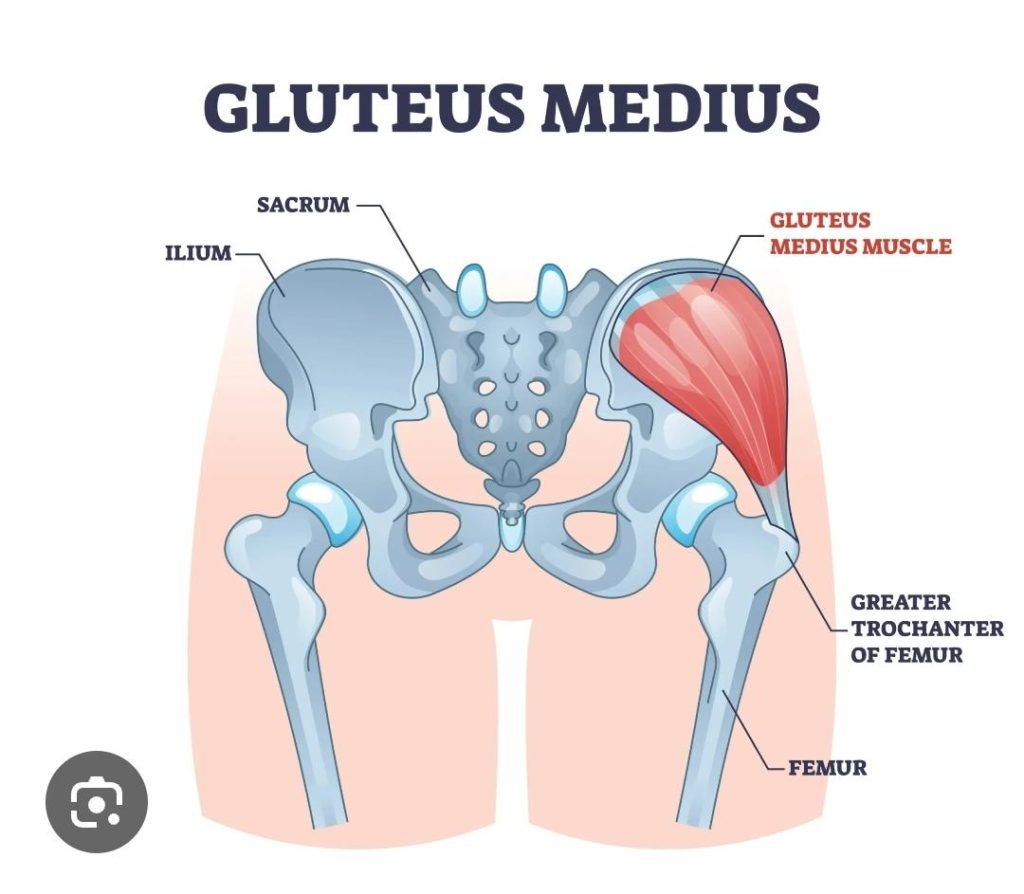
When you look at that muscle, you can see that the lines of the muscle fibers run mostly vertically up and down. It does the most for hip extension. Hip extension just a technically term for straightening your hips like when you stand up (or thrust like… you know what, you know what I mean).
The biggest challenge with Hip Extension is that it’s not the only large muscle that does extension. The hamstrings also contribute, and so can the low back. Oftentimes, people OVER extend and the low back does all the work (and increases risk of back injury). Sometimes, people don’t extend enough and the work is done just with the hamstrings.
The Glute med lives in this middle range of full extension but not over-extension. The best way to visualize this is standing tired and slouched (under extended/flexed), standing tall (full extension), and standing tall while arching backwards (over-extension/hyper-extension).
So how do you exercise the Glute Medius?
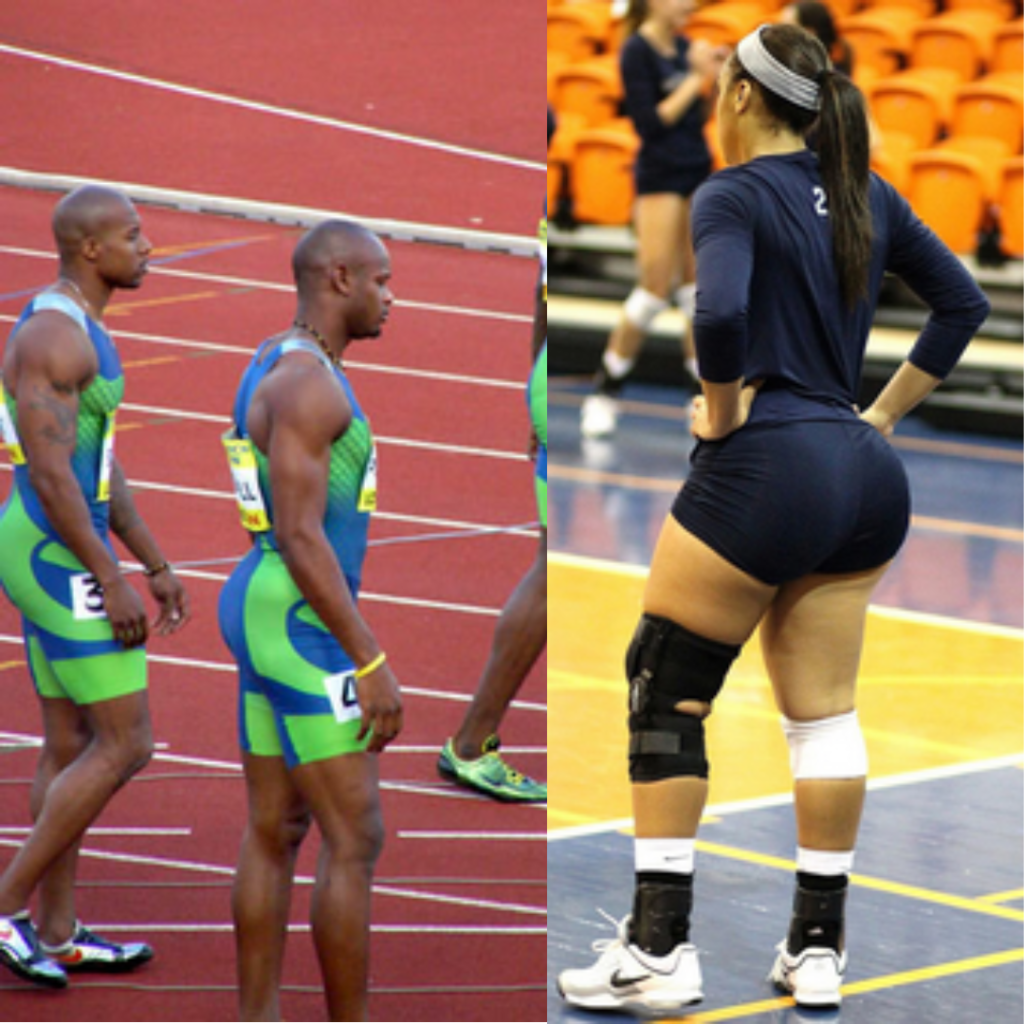
There are actually a few ways to really hit the glute med super effectively. We can see in sport two of the biggest ways by looking at which athletes have the biggest ‘donk.
I remember in high school I did some indoor track races in the winter. I was a long distance runner, and while I waited for my race to come up, I remember watching the sprinters race. And let me tell you, watching those college sprinters run by, I could not peel my eyes off them. It wasn’t for the athletic performance either. Sprinters got ALL the junk in the trunk.
Then in college, I spent some winters watching volleyball matches when I had some exra downtime. I wasn’t particularly interested in the game (I do really enjoy watching 2v2 beach volleyball during the olympics though because it’s fast paced). I was there to watch the other bulbous objects bounce around. Whew, have mercy.
BIG WORD OF CAUTION!!!
Not everyone should do sprints or jumps. Those are pretty high intensity, high demand exercises that can hurt joints if you’re not conditioned for them. Build up to them. For sprinting, start with walking workouts, then jogging workouts, then periods of faster jogging in workouts. For Jumping, avoid having a BMI in the “obese” range, and have a good base of strength training with squats, then progress to lunges, then to step ups. Then do gentle hops in place before attempting bigger jumps.
If you have Knee Issues, don’t think about sprints and jumps. Not worth it.
Low-Impact ways to hit the Glute Med
There are Low-impact, knee friendly ways to hit the glute med while strength training. And it’s by emphasizing the extension WITHOUT HYPER EXTENSION!!!
Can’t emphasize that enough… we don’t want hyper extension because that can hurt the back, but a full extension of the hips can help hit the Glute Med better. Minimal extension will work the hamstrings, but not get the glute med until you get a full extension.
There are a few prime exercises that hit the hip extension marvelously. With two legs, the best hip extension exercises I know of that don’t put you at risk of hyperextension are Kettlebell Swings (hard style) and Cable Pullthroughs.
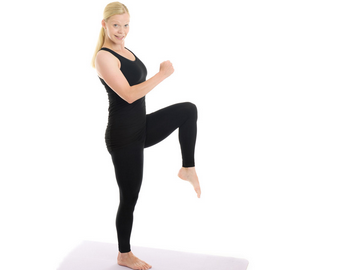
Another phenomenal way to get more glute med recruitment when doing single leg exercises is to finish with a knee lift. You can try this right now. Stand up. Go ahead, I won’t make fun of you if you feel silly.
Place your left hand on the top of your right butt cheek where the Glute med is. Now, lift your RIGHT knee up until your knee if even with your hip and you’re standing on your left leg.
Feel that buttcheek fire up? That’s because this knee lift position forces the hip to rotate into a super full extension position and fires that Glute Med right up.
For more glute med on your lunges, step ups, or single leg RDLs, finish with a knee lift position.
How you get all that junk, all that junk up in that Trunk? The Big Booty Muscle -- Glute Max
Ask the average person what muscle makes up the butt, and they’ll say Gluteus Maximus. For good reason. It’s the biggest muscle, it has a funny name, and it gives the most size to the Derriere.
And the gluteus maximus is a shockingly difficult muscle to hit. The reason why is because most of the muscle fibers run pretty horizontal, while most exercises run vertically.
This means a lot of “glute” exercises people expect rarely work the glutes. Like Squats. Yes… Squats are actually a bad exercise for glutes (They are an amazing exercise for leg strenth and have a tremendous amount of functional carryover to daily activities!! Squats are amazing and we should all do some sort of squat exercise in our workout plan!! It’s just not optimal for dem booty cheeks)
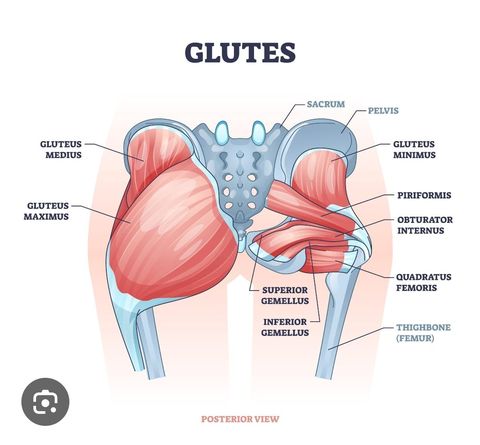
Because the muscle fibers run horizontal-ish, one of their biggest functions is to rotate the thigh out laterally. In layman’s terms, it helps turn your knee out.
This is HUGE for knee health and joint stability! The glutes are actually one of the biggest knee stabilizers even though it isn’t actually that close to the knee. If you want healthy knees now and when you get older, getting some tooshy is one of the smartest things you can do!
It’s sexy, too 😅😅😅
So!! How can we take advantage of this? My biggest recommendation is single leg exercises like lunges (reverse lunges especially)
Lunges hit the glutes really well for 2 reasons.
- First, any single leg exercise is going to challenge the balance and stability of the knee joint. That makes the glutes fire harder.
- Second, in the bottom position, your hips tuck and rotate underneath. This angles the glute fibers to now be orientated vertically against gravity which means they’re now the muscle in direct opposition and doing work to lift your body.
Taking advantage of Horizontal Angles
Another great way to hit the glutes, and one of the few fitness fads that is actually effective, is by creating horizontal resistance with elastic bands. Since the fibers run horizontally, if we change the angle of resistance to match, we change which muscles need to be used.
The most common way to do this is with those small ankle bands (I prefer to place around the knee instead). Then you can do walking exercises (side to side, forward, or backwards) or just add more horizontal resistance to other exercises like squats.
Recap! How to train the Glutes the Best
This is grossly simplified, but…
- For most “shape” and knee health, Glute Max is the go to muscle
- Because Glute Max runs horizontal, we want to do more single leg exercises or exercises with horizontal resistance bands
- Exercises like Lunges and banded walks hit glute max best
- For that perky shelf and for low back health, Glute Med is the go to muscle
- Because Glute Med works most on hip extension, we can get a lot of glute training with sprinting, jumping, cable pull-throughs, kettlebell swings, or knee lifts
Now… I don’t recommend doing all of these exercises every workout. But sprinkling some of these in throughout the week is a great idea.
If you’re looking for a personalized workout plan that can help work your butt, as well as the rest of you, tailored specifically for your goals and needs, you should consider one of my coaching programs. You can get more information by sending me a message
If this gave you some insights into more effective exercise planning, hit one of the share buttons below or just send this to someone who would like to shake their money maker a little bit more (or have more money maker to shake!)