
I’m excited to share my insights into how to make a home gym in 2024. There are a lot of mistakes I see people make all the time which I’ll help you avoid with my Home Equipment Matrix.
I’ll be honest, my home gym is nothing special. But it’s functional and cost me only a couple hundred bucks to get started. My brother’s home gym… He balled out and bought the largest and top-of-the-line equipment that cost him several grand.
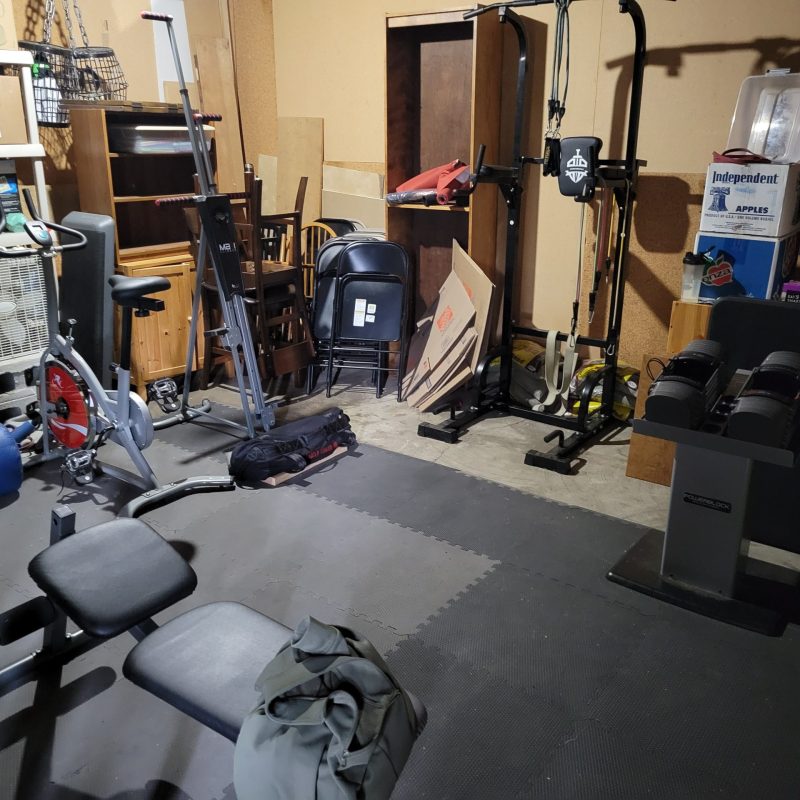
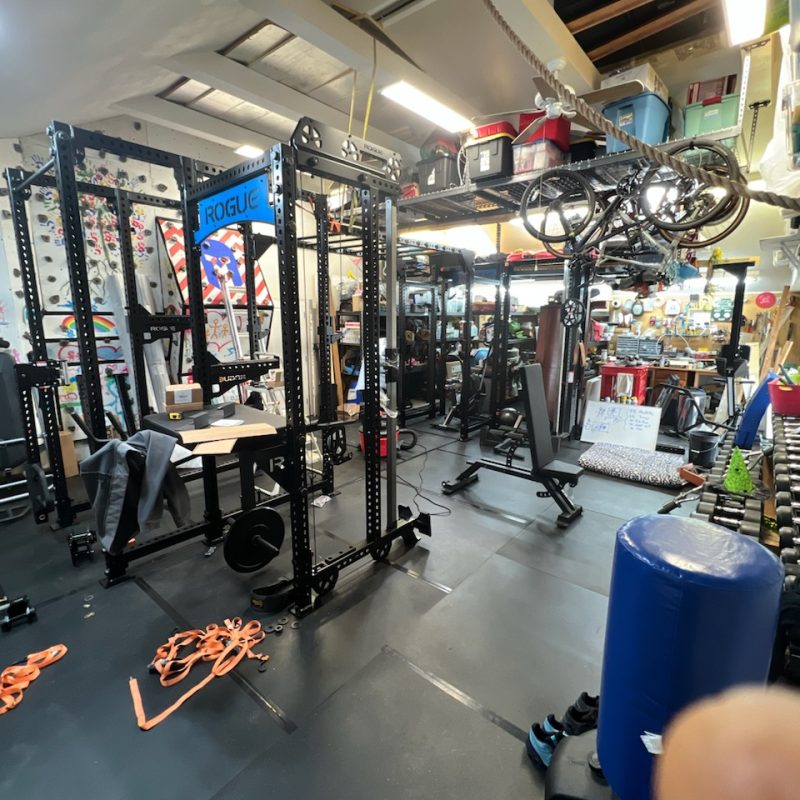
I’m going to teach you how to make a home gym that fits you, your needs, and your budget.
I’ve been working out at home since the pandemic, and a lot of my online personal training clients choose to workout at home as well. There’s so much more convenience working out at home!Tthere’s more privacy, and there’s a special level of ownership when it’s your own private space. There’s a lot of perks, but there’s also some drawbacks…
Most home gyms lack space. This also means that they tend to lack a large variety of equipment (a problem that can be quickly exaggerated if you buy stupid equipment and waste both space and money). Rather than let those drawbacks be hindrances, I’m going to walk you through how to make a home gym that gets you the most bang for your buck AND matches all your needs.
First thing to consider!
The most important step to buying exercise equipment for making your home gym is to first address why you need a home gym.
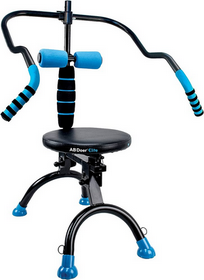
This is a crucial step when you start to make a home gym in 2024. In the 90’s, we bought any shiny thing we found on an infomercial ad (and regretted it massively). I can say that because my dad bought some sort of bendy ab chair thingymajig when I was a kid and lemme tell you… don’t do that. Don’t buy stuff just because the infomercial says it’s for home exercise. Buy things based on what’s important to you.
1️⃣What workout preferences do you have?
2️⃣What goals do you have?
3️⃣Do you plan to do all your workouts at home, or just some?
YOUR answer to these questions will help guide you to picking the right equipment for you and your home gym. I’ll answer the questions for myself and for my brother.
What workout preferences do you have? I personally like a blend of circuit training and traditional dumbbell strength training. My brother likes bodybuilding training and he likes competing in Spartan Obstacle Course Races. As you can see, we bought different equipment for the different preference.
Others may have a stronger cardio preference, or max strength (like powerlifting) and bodybuilding preferences. Others want to do CrossFit style workouts.
What goals do you have? My biggest goals, in my mid thirties and with a steel rod in my left knee, are to feel amazing, look amazing, and be the world’s most fun Uncle. Essentially what some call “Functional Fitness.” I just want to have the fitness levels to play however I want and not be limited by my knee accident from 2019. My brother wants to maintain muscle mass in his 40s while also competing in obstacle course races (He actually qualifies for the Elite Spartan Races!).
Others may have sports goals, bigger bodybuilding goals, or some other goal that you’ll want to select equipment for specifically.
Do you plan to do all your workouts at home, or just some? Almost all my workouts are done at home, except for some outdoor playing like hikes or swimming. This means I need to cover all my bases as best as I can. My brother has recently shifted to doing all his workouts at home, though that was not his original plan.
Some people only plan to do weights at home and keep cardio at the gym (or vice-versa). Some plan to do general workouts at home and specialty workouts at the gym (or vice-versa).
If you’re doing all your workouts at home, you need to cover more bases. If you’re only doing some, then you only need to cover some essentials.
After priorities, now figure out your space
Figuring out your priorities is an important first step since it highlights what equipment you’ll need when you make a home gym in 2024. If you’re doing specialty workouts at home for a sport goal or to accommodate a specific injury, then you’ll want special equipment for that. I have a friend (not me actually) with a knee issue, and they prefer to do a lot of “belt squats” for their leg workouts. That’s a special piece of equipment that few gyms have, so that became a priority.
But what is the point in buying special equipment for your home gym if you don’t have the space for it?
That’s why we need to figure out your space next. (or first? Hard to say. Still figure this out before you start getting home gym equipment though). Where will you be working out? In a spare bedroom? In the garage? In a shared space that will need easy to store equipment? How much space do you even have? What’s the floor like there?
For me, I have done both spare bedrooms and garages. Garages potentially have more space, especially with ceilings, so I liked that experience a lot more. Different homes have different options.
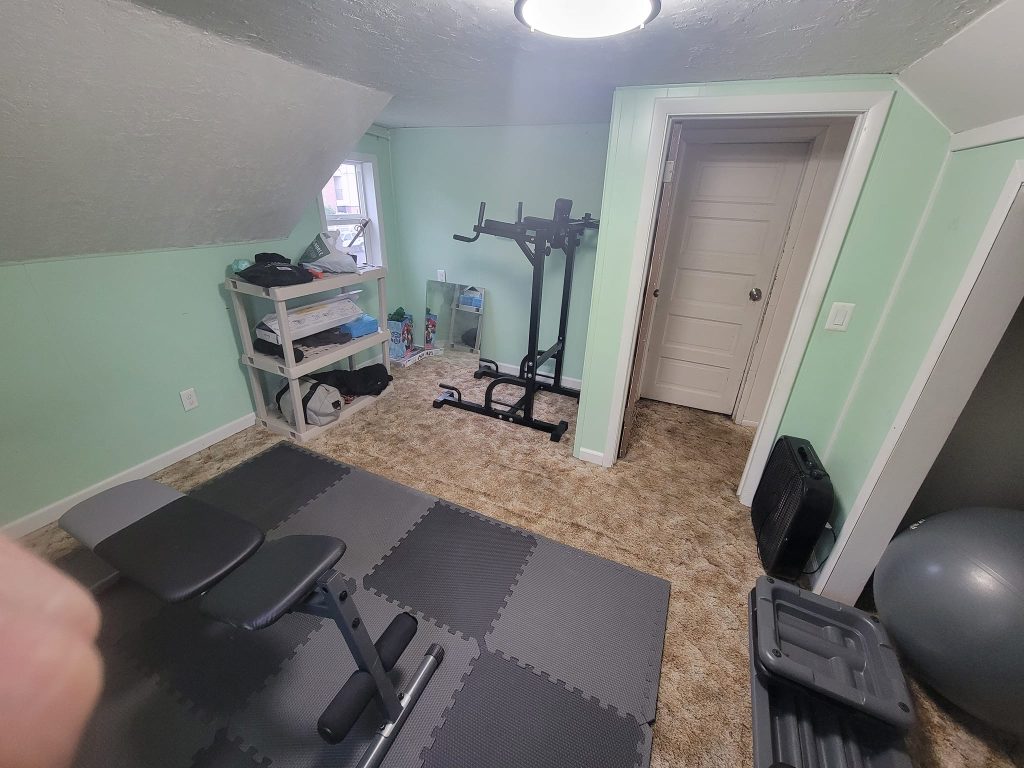
Figuring out your space is going to give you two big answers. Do you need to get flooring, and how much stuff can you even get?
Flooring… Is it necessary?
At the end of the above section, I mentioned how first evaluating the space can help you determine if you need to get any special flooring for your workout space.
The easiest place to start is whether the space is going to be dedicated to workouts or not. If it’s not a dedicated space, then no. Buying flooring is impractical. A beach towel or rolled up yoga mat will be fine, depending on how much padding you want or need. If it is a dedicated workout space, either a spare room, corner of a larger room, garage, or basement, then we can ask a few more questions.
If you have a softer carpeted floor (common in basement or spare rooms), you probably don’t need to get any additional flooring. Flooring drops from a priority to a bonus. If you have concrete flooring (common in garage spaces), and plan to do no or minimal floor based exercises (planks, situps, pushups, etc) then flooring also drops from a priority to a bonus. For hardwood or laminate surfaces, or if you plan to do a lot of floor based exercises, flooring is a good item to put on your priority list (though maybe not the first item, we’ll chat about priorities soon).
Although… If you’re sweating a lot directly on carpet, you’ll probably need to shampoo those carpets more often. But a towel works fine as a barrier (towel under bikes or as a yoga mat work fine.)
My history with flooring: When I first made a home workout space in response to gym closures in 2020, I was working out in my bedroom doing just bodyweight exercises. My bedroom had carpeting, so I just used a towel to catch my sweat. Sometimes I had a yoga mat. As the quarantine continued, I cleared space in my garage and got some more equipment. With the concrete floors and my tendency to do floor based exercises, I ended up getting some padded floor mats. Floor mats were my 4th purchase though, so not the most important unless you’re planning to go big out the gates.
What floor mats to get: Depends on the amount of space you need. Initially I just needed enough for my body, so I started with a towel or a yoga mat. Because my workout space grew, but has always been contained to a space smaller than 10’x10’ I just got a couple packs of those interlocking workout mats. I don’t think the brand really matters on those. My brother turned his entire garage into a gym and needed a LOT of flooring, so for the best value he bought some cow stall mats from the local farm supply store.
- Just you? Towel or Yoga Mat
- Small Space?
- Interlocking floor mats
Large Space? Cow Stall Mats
ALRIGHT!!! LET’S BUY SOME TOYS!!!

Holy crap. I just wrote almost 4 pages of stuff already and I’m just getting to the only thing I planned to talk about… picking equipment. What the hell? I wrote a paragraph about how “my gym is my gym and may not be your gym. You gotta prioritize based on individual needs and wants” and then WHAMMY! 4 pages later. I didn’t even plan to talk about flooring, yet there it is…

Anyway, meta-commentary aside, I want to walk you through my process and priorities when picking out equipment so you can have a super awesome, super useful gym that avoids that bendy ab chair thing.
Earlier I asked if there was any specialized equipment you needed. Although this is really unlikely, some people do. So start with that (and then re-evaluate how much space you have left over. Special equipment is rarely small). After the special equipment, let’s start judging and selecting everything else that remains
🤬🤬AND NO!!! THE AB-DOER CHAIR DOES NOT COUNT AS SPECIAL EQUIPMENT🤬🤬
My Home Equipment Matrix
There are two and a half considerations I made when I was looking to make a home gym, and they’re the same things I tell my online personal training clients to consider if they want to make a home gym in 2024. Those are Versatility vs Space (vs Cost… we’ll chat more about cost later).
Versatility
When prioritizing equipment, I like to consider them based on how big it is and usability. If I can do more exercises with a piece of equipment, it’s more valuable to me than single-exercise equipment. For example, you can buy a home cable weight machine like the one pictured below, but it only does 3-5 exercises. A set of dumbbells can do hundreds of exercises. For a home gym, I think dumbbells make more sense to prioritize over weight machines
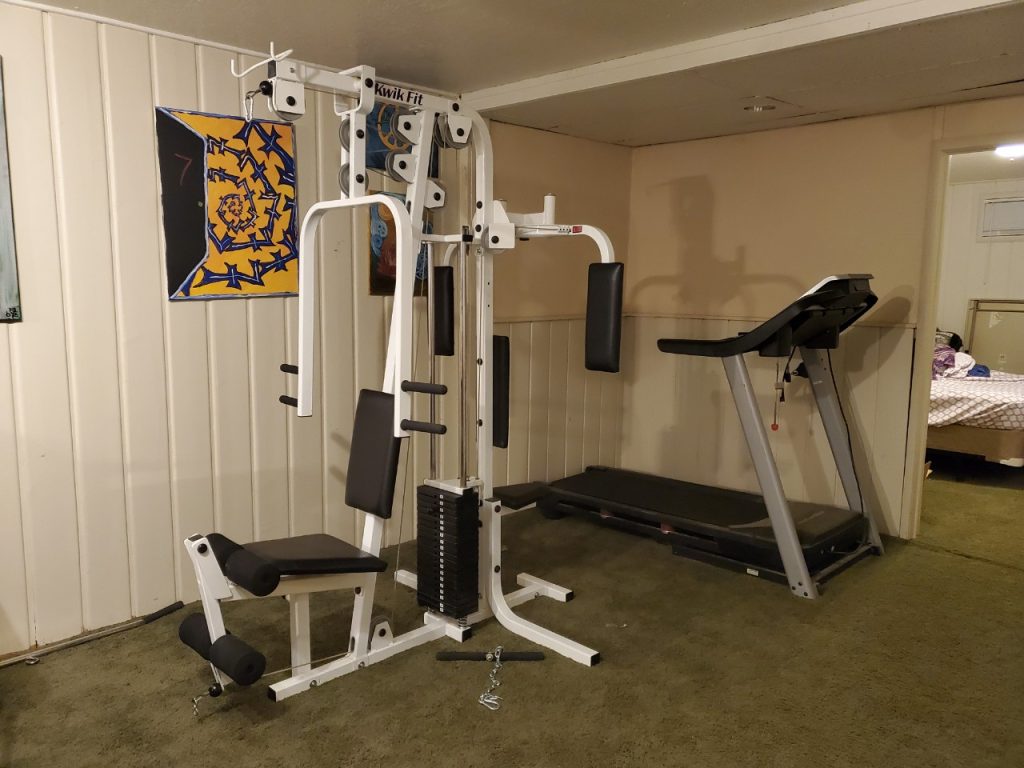
You remember that bendy ab chair thingy? Yeah, that only does 1 thing. 1 exercise for $300. My dumbbells cost me $300 (or did they🤔 wait for the cost section) and they do hundreds of different exercises. Dumbbells > Ab Bendy chair thingy.
Before buying home exercise equipment, ask how many exercises can you do with this thing? Things that do more are a higher priority when making a home gym in 2024.
Space
One of the drawbacks to home gyms is that, unless you’re Dwayne Johnson apparently, you’re just not gonna have the 10,000 sq.ft. that a big commercial gym has. Your local 24 hour fitness just has more space to have more stuff. They can afford to buy things that take up extra space. Most of us can’t.
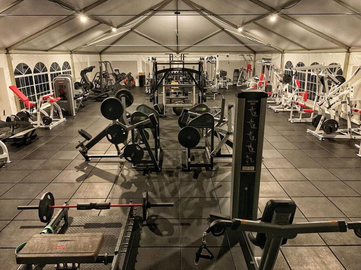
I also use space as a judge for what’s more valuable. You remember that photo above of that big old cable weight machine thing that did 5 exercises? It also took up an insane amount of space. I have a set of resistance bands in my garage that store in a 1 cubic foot bag. That’s almost no space at all, so I consider exercise bands more valuable and a higher priority.
Before buying home exercise equipment, ask how much space will this take? Things that take up less space are a higher priority when making a home gym in 2024. At least in my opinion.
Secret Matrix Element: Cost
Cost is something to consider when purchasing home equipment. I would always ask yourself if what you’re buying will get used enough to be worth the cost. There’s more equipment I can add to my home gym that would be fun, but realistically would only get used a couple times a year. Just not worth it. For me, this is a rower machine. I would definitely enjoy it, but it’s not a form of exercise I do super often, and a new Concept2 Rower costs $1000.
To spend $1000 for something I’ll use maybe 10 times a year? That’s $100 per use. To me, that’s just not worth it. (I’ll talk about this a little more below because I have equipment that’s not worth it until I changed the price)
Cost isn’t something I can add as strictly in on my Matrix as I can with Versatility and Space because equipment cost is not universal. There are loads of ways to adjust the cost of equipment. Some things to consider.
Brand– Just like food and medicine and electronics, sometimes the brand changes the cost of things. I’m a big fan of suspension training systems. The big name brand in that space is TRX, but there are many comparable alternatives at different costs. My suspension training system from KB Duo Training cost me $50 while the TRX trainer cost $180.
New vs Used– Used equipment is gonna be buttloads cheaper (usually), but take much longer to find. The costs can be 50-90% less though, so it’s worth checking used places first (especially since most used exercise equipment was hardly used more than a week before forgotten). Places to check include Facebook Marketplace, Craigslist, OfferUp App, and local 2nd hand stores. I bought my adjustable incline bench from a 2nd hand store (brand new though!) for $60 when they normally retail for $200-$600
Trades– Sometimes you can trade for gym equipment. A lot of times, people have stuff they don’t want, and maybe you have something that’s more interesting. Remember above how I said sometimes equipment costs too much to be worth it? That happened to me. I have the Powerblock EXP adjustable dumbbell set. They start at 5-50lbs, but there’s an expansion kit that let’s it go up to 70lbs. There’s another expansion set that takes it up to 90lbs. I bought the first expansion, and wanted to the second expansion set. The problem was that I don’t use 80 or 90lb dumbbells enough to spend $130 on them. My friend wanted me to help him with some lawn care, and I had a lightbulb moment. I told him I’d help him with landscaping over the weekend if he bought the expansion set for me. Boom! Free dumbbells instantly made it way more worth it.
Using the Matrix for general recommendations
Using the Versatility/Space/Cost Matrix, there are some home gym priorities I recommend for everyone. As we discuss these things, you’ll see how the matrix helps prioritize. My favorite home gym equipment
1) Stackable Resistance Bands LIKE THESE ONES FROM FLEX COMICS
Versatility: 10 out of 10. With these, you can do hundreds of exercises and target every muscle in the body. And the stackable bands give you not just 5 weight options for the 5 individual bands, but 30 different weight combinations of 1-5 bands (trust me, I did the math). Between 30 different weight levels and hundreds of exercises, you get a ton of versatility.
Space: 9.5 out of 10. In storage, these bands fit into a 1 cubic foot bag. That’s about the size of a shoebox. Tiny. In use, some exercises take up no additional space and fit in line with your body (band curls, Overhead press, squats, etc). Some exercises can take up to 5 feet of space. And, the half point deduction, some exercises like Band Rows require anchoring on something sturdy like a door frame, wall anchor, or heavy furniture. But still, very tiny space to use and store. Awesome
Cost: Brand New from Flex Comics, these cost about $20. Fuck yeah that’s awesome. No two ways around it (I bought somewhere else in 2016 for $50 with no regrets, so $20 is incredible in 2024)
Rating…. Essential. Low cost and almost infinite workout options
2) Sliders
Versatility: 6 out of 10. There are several really great exercises you can do with sliders. And there are A LOT of mediocre exercises you can do with them, too.
Space: 10 out of 10. These take up absolutely no space, they’re only a couple inches big. And they take up 0 additional space while using because they follow your body.
Cost: 10 out of 10. Exercise Sliders cost about $30. Furniture sliders cost about $10. (Disclaimer: I would never advise you to use stuff for exercise that wasn’t made for that explicit purpose for safety and liability reasons. Ignore the fact that I’ve been using furniture sliders from Home Depot since 2012)
Rating…. Practically essential because of low cost and increased exercise options
3) Suspension Trainer System
Versatility: 9 out of 10. Tremendous amounts of exercises you can do, and some really great ones (especially for your back).
Space: 8 out of 10. In storage, they take up less than a shoebox. In use, they usually need about 6’ x 3’ of space. The challenge with suspension straps though is finding a good anchor. They often come with a door anchor, and you can purchase an x frame anchor that bolts into a wall stud, but my favorite is anchoring it to the ceiling, rafters (like in my garage), or to a pullup bar. If traveling, you can anchor to tree branches and tall fences.
Cost: 7 out of 10. You can get some generic ones like the KB Duo version I use for $50. If they were my first use of suspension straps, they’re probably be perfectly fine, but I do prefer the TRX name brand version (the straps are thicker, sturdier, and the lock pin is easier to adjust and set evenly). They come in at $230-$300
Rating… First cheap non-essential option
4) Adjustable Dumbbell Set (Especially PowerBlock or BrainGain Dumbbells)
Versatility: 10 out of 10. You can do almost anything with these bad boys. And if you get adjustable dumbbells, you get a ton of different weight options in one small device
Space: 9.5 out of 10. Dumbbells store in a real small space. Sometimes they take a little more space if you get an additional storage stand vs leaving them on the floor. They also don’t take up anymore room to use than your own body does (unlike Barbells that require 7 extra feet of space).
Cost: 4 out of 10. Adjustable dumbbells are more economical than a complete dumbbell set. I have the Powerblock exp with stand (5-90lbs) and it cost me a total of about $650. Obviously doing 5-50lbs costs significantly less, about $300. My brother has a complete set of individual dumbbells (5-100lbs) with racks and it cost him almost $3000 (10x as much as I spent initially). That being said, adjustable dumbbells are still the most expensive item I’ve listed so it can’t score as high as the $20 bands.
Rating… First expensive non-essential purchase
5) Small-medium dumbbells (individual)
Versatility 6 out of 10. You can do a lot with dumbbells, but some exercises just don’t work well if you have the wrong weight (either too light or too heavy). If you have 15lbs dumbbells as a healthy male, they’re just not gonna mean anything for squats because they’re too light. On the otherside, if you only have 35lbs, chances are you won’t do much with shoulders as an average woman because they’re too heavy. Because of limited weight options, it’s less versatile than adjustable
Space: 3-8 out of 10. If you only have a couple pairs of dumbbells, they don’t take up much space. But for each additional dumbbell pair you get to give yourself more weight options, you lose space.
Cost: 3-8 out of 10. A pair here or there, not too bad. To get a lot of dumbbells, cost goes up a lot. Like my brother’s $3000 set
Rating… Can be cheaper initially to get a couple than to get an adjustable set, but an adjustable set is more versatile, space saving, and cost effective if you decide to make the investment.
6) Sandbag
Versatility: 5 out of 10. You can do a lot of things with a sandbag, but not a lot of “necessary” things. I have one mostly out of accident because I got it for personal training workouts, but after my knee reconstruction it’s been my main weight for squatting exercises. The weight is tough to change though.
Space: 9 out of 10. It takes up the same amount of space as a gym bag. It’s small. Using it takes up same amount of space as your body.
Cost: 8 out of 10. The bag will cost about $100. Play sand is cheap at the hardware store (NOR RECOMMENDED BECAUSE RANDOM DEBRIS CAN DAMAGE THE SANDBAG!!! Dirt is free in your backyard).
Rating… Non-essential bonus that has a lot of uses
6) Barbell
Versatility: 7 out of 10. You can do a lot of exercises and exercises for every muscle. But… Being a two handed bar does give you less options that dumbbells or bands.
Space: 2 out of 10. Not only are bars 7 feet or longer, you often need a lot of additional equipment. A squat rack, extra weight plates, a place to store the weight plates. This all has a massive footprint and takes up a lot of space.
Cost: 2 out of 10. The bar itself costs $100-$300 for good quality. The additional weights will cost several hundred more. And the rack to do squats and presses from will cost a few hundred to a couple grand. All in, you’re looking at a very sizable investment.
Rating… Expensive and Non-Essential except for very specific strength training or crossfit lifts. (I never recommend barbell equipment to my clients for the cost and they can sometimes be way harder on joints than bands or dumbbells. Bands and Dumbbells are magnitudes better purchases)
7) Various cardio pieces
Versatility: 2 out of 10. Usually you can only do one exercise (bikes only bike, rowers only row, etc). Some have various “modes” that give different options. All can have different workout modes done by you (known as “interval training”)
Space: 2-7 out of 10. Some cardio equipment is huge (like a treadmill) and some are small (like a spin bike or a maxiclimber) and still some are kind of medium sized (rowers and some ellipticals).
Cost: 1-10 out of 10. Some can cost thousands of dollars. Others cost significantly less. I got a cheap Sunny spin bike on sale that cost me about $70, and I got a used maxiclimber off facebook marketplace for $50. My brother has a brand new assault airbike and a rower, and he spent 5x more than I did for each.
Rating… If you have space and money, it’s very nice, especially depending on your deal. Otherwise you’ll do a lot of outdoor or bodyweight cardio exercises. Not essential unless you have the space and money, but right next to essential.
See how that matrix works? We can judge equipment by how much space it takes and how much use we can get. Then, based on the cost, we can decide if the equipment is worth investing in.
RECAP! Real Fast...
So overall, in recap, we want to consider the following.
- Personal “Needs” or preferences.
- The space you’ll be working out in
- The floor you’ll be on
- How much use vs space required (and then cost depending on a few factors)
General Equipment Recommendations
My general “essential” and “Near essential” recommendations for General Fitness and Wellness at home.
Essential:
Viable Floor option
Stackable Resistance Bands
Sliders
Near Essential:
Suspension Trainers
Light to mid Dumbbells
Adjustable bench?
First Big $$ Purchase
Adjustable dumbbell set
Cardio Equipment
Alright... But what do I actually have???
Sure… You wanna know if I practice what I preach. Well, let’s go then!
Here’s a list of the odds and ends I have in my garage gym.
- Powerblocks Adjustable Dumbbells (up to 90lbs)
- Adjustable bench
- Exercise Ball
- Bosu Ball (I forgot I had this… I haven’t used it in like a year 😅)
- Interlocking Floor Mats
- Pullup & Dip Station (mostly to anchor my suspension trainers)
- Suspension trainer
- Set of stackable resistance bands
- 1 x 25lb weight plate (I have no idea where this came from and I almost never use it)
- 55lb sandbag
- Sliders
- Stationary Bike (cardio)
- Used Maxi Climber (cardio)
- Foam Roller
Not everything in my list is an “essential” item, but my job and passion is fitness, so it’s cool for me to get some bonus toys
Hey, and if you want help using your new home gym equipment with a personalized workout plan built based on what actually made it into YOUR home, shoot me an email Steven@ThrivingBody.Fit with the subject line “Coaching”